What is Mechanical Ventilation?
What is Mechanical Ventilation?
Mechanical ventilation (MV) is a method of support for the treatment of Acute or Acute-on-Chronic Respiratory Failure, using positive pressure to assist or replace spontaneous ventilation. Understanding its fundamentals is essential for nurses, physiotherapists, and physicians working in intensive care units.
Ventilatory Support: Objectives and Modalities
Ventilatory Support: Objectives and Modalities
The main objective of ventilatory support is to improve gas exchange, reduce respiratory work and effort, and decrease oxygen consumption. It can be performed Non-Invasively (NIV) or Invasively.
Non-Invasive Ventilation (NIV)
Non-Invasive Ventilation (NIV)
NIV is indicated for patients with minute volume > 4 L/min, PaCO2 < 50 mmHg, and pH > 7.25 (acidemia or acidosis). Its goal is to prevent progression to muscle fatigue and/or respiratory arrest. The main determinants are:
- Inspiratory Pressure (IPAP or PSV)
- Expiratory Pressure (EPAP or PEEP)
- CPAP: Continuous Positive Expiratory Pressure
Common devices include ETT, nasotracheal tube, tracheostomy tube, and laryngeal mask.
Invasive Ventilation
Invasive Ventilation
In invasive ventilation, parameters must be adjusted precisely:
- Tidal Volume (VT): 6 ml/kg, using Predicted Body Weight (PBW)
- Men: 50 + 0.91 × (height in cm – 152.4)
- Women: 45.5 + 0.91 × (height in cm – 152.4)
- Respiratory Rate (RR): 12-16 breaths/min
- Inspiratory/Expiratory Ratio (I:E): 1:2 or 1:3
- Sensitivity: usually 2 L/min (for A/C mode)
- PEEP: adjusted in combination with FiO2 to maintain alveolar perfusion (5-10 cmH2O)
Important notes:
- Maintain continuous pulse oximetry
- Perform blood gas analysis 30 minutes after MV initiation
- Assess hemodynamic repercussions, especially in patients with heart failure or acute pulmonary edema
- Asynchrony can occur in 10-80% of patients, especially when ventilator sensitivity is inadequate and the patient has respiratory drive
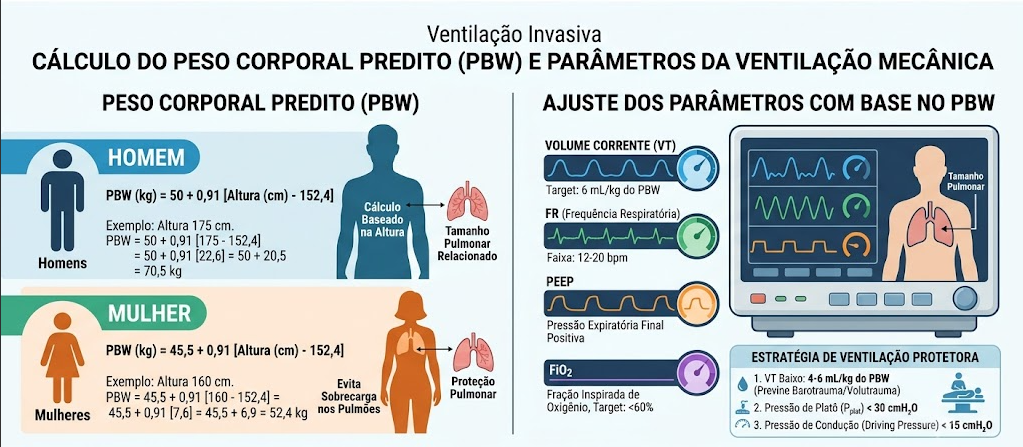 Cálculo do Peso Predito (PBW) na Ventilação Invasiva
Essential Concepts: Ventilation, Oxygenation, and Perfusion
Essential Concepts: Ventilation, Oxygenation, and Perfusion
Ventilation is different from oxygenation, which is different from perfusion. Each concept involves a different diagnosis, and the clinical picture combined with blood gas analysis will dictate the scenario.
- Compliance: elastic force/alveolar tension, directly corresponds to the maximum volume/pressure of the alveolus.
- Resistance: dictated by pressure/airflow.
Nursing Diagnoses (NANDA) and Interventions (NIC)
Nursing Diagnoses (NANDA) and Interventions (NIC)
Impaired Spontaneous Ventilation
Impaired Spontaneous Ventilation
Expected Outcome (NOC): Respiratory Status: Ventilation
Nursing Interventions (NIC):
- Ventilatory assistance
- Oxygen therapy
- Respiratory monitoring
- Mechanical Ventilation Management: Invasive
- Assemble the circuit with inspiratory and expiratory limbs and monitoring cables
- Check connections to ensure they are secure
- Configure the device – physician and physiotherapist
- Turn on alarms
- Educate the patient and family
- Assess need for sedation and neuromuscular blockers (collaborative)
- Monitor MV effectiveness (blood gas analysis) on physiological and psychological status whenever adjustments are made
- Provide alternative means of communication
- Drain condensed water from the circuit
- Document MV settings and changes
- Monitor adverse effects: tracheal deviation, infection, barotrauma, volutrauma, reduced cardiac output, gastric distension, subcutaneous emphysema
- Monitor for detection of oral, nasal, tracheal, laryngeal injury – artificial airway and fixations
- Position in bed for good ventilation/perfusion (good lung down) – discuss with team (Fowler or Semi-Fowler, RLD or LLD?)
Ineffective Airway Clearance
Ineffective Airway Clearance
Expected Outcome (NOC): Respiratory status: airway patency
Nursing Interventions (NIC):
- Artificial airway management
- Change to oropharyngeal airway – if biting on ETT
- Humidification/heating of gases
- Maintain good systemic/oral hydration
- Keep cuff inflated at 15 to 25 mmHg
- Monitor cuff pressure every 4-8h
- Auscultate chest after each ETT manipulation
- Check internal pressure with cuff manometer whenever patient is repositioned
- Observe the rim and maintain its positioning
- Keep the MV circuit in constant support, avoiding traction
- Ensure ETT safety during position changes, oral hygiene, suctioning
- Perform tracheal suctioning if necessary
- Record secretion characteristics
- Oral care: hygiene, suctioning, hydration
- Monitor MV pressures and volumes (increased inspiratory pressure and decreased expiratory volume)
- Keep manual resuscitation bag assembled at bedside
- Head of bed elevated
- Tracheostomy – hygiene, dressing
- Inspect peristomal skin: drainage, erythema, irritation, bleeding
- Palpate for subcutaneous emphysema
- Change fixation daily or as needed
Ventilatory Modes
Ventilatory Modes
- VCV (Volume-Cycled Ventilation): Predetermined VT – caution with barotrauma and pneumothorax. Inspiratory pressure is limited by the ventilator.
- A/C (PCV): Variable VT, as the patient determines movements and the ventilator maintains positive end-expiratory pressure (PEEP).
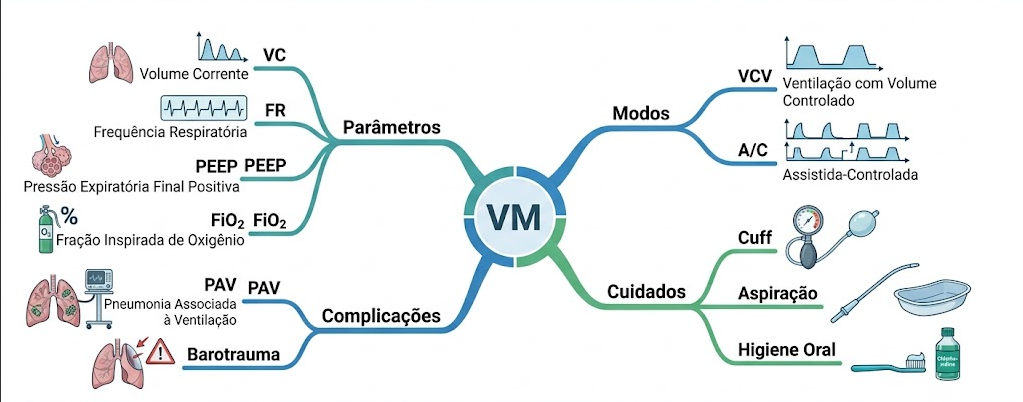 Mapa Mental: Ventilação Mecânica
Relevant Aspects in Practice
Relevant Aspects in Practice
- Check and record programmed and delivered MV parameters
- Ensure continuous pulse oximetry
- Install capnograph if possible
- Collect blood gas ~20 min after any adjustment or when clinical status changes, and once daily in the acute phase
Prevention of Ventilator-Associated Pneumonia (VAP)
Prevention of Ventilator-Associated Pneumonia (VAP)
VAP can occur generally 48h after intubation. Preventive measures include:
- Change circuit if soiled (e.g., blood, vomit) or damaged
- Change humidifiers every 7 days
- Use cuffed tubes to prevent aspiration
- Cuff pressure – minimum 25 cmH2O (depending on reference)
- Head of bed elevated 30 to 45°
- Oral hygiene with 0.12% chlorhexidine mouthwash
- Daily sedation interruption
Ensuring Minimal Occlusive Volume
Ensuring Minimal Occlusive Volume
- Suction oral cavity
- Position stethoscope laterally to the trachea
- Inflate the cuff and auscultate for sounds of air passing
- Stop inflation when sounds cease
- Remove 0.5 ml (from syringe) until you hear the sound of air passing again
- Reinflate SLOWLY until the sound ceases again
- Check pressure with cuff manometer
- Record
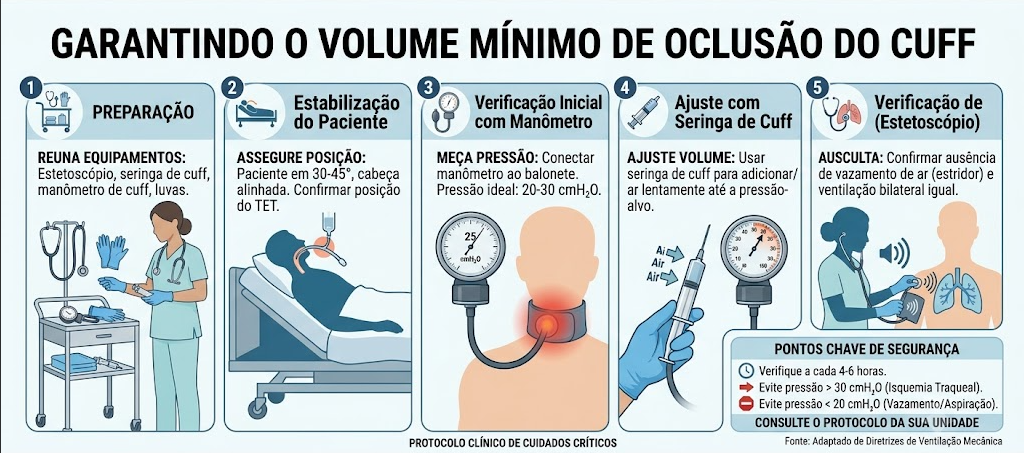 Passo a passo: Garantindo o Volume Mínimo de Oclusão
Respiratory Failure
Respiratory Failure
Inability of the lungs to efficiently perform gas exchange to maintain aerobic metabolism and CO2 excretion.
Can lead to Hypoxemia (ARDS, PE) and/or Hypercapnia (COPD – Asthma, Bronchitis, Emphysema).